
The panel saw is one of the most essential pieces of equipment in the manufacturing of panel-based furniture, cabinetry, and wardrobes, as well as in custom woodworking workshops. As the critical first step in the panel processing workflow, the performance of a panel saw directly determines cutting precision, material utilization, edge quality, the caliber of the finished product, and the overall production capacity of the workshop.
For many owners of woodworking enterprises, importers, distributors, and factory procurement personnel, selecting the right panel saw has always been a challenge. A large number of buyers focus solely on the initial purchase price, only to end up with low-cost equipment that suffers from poor structural rigidity, frequent edge-chipping, significant dimensional inaccuracies, and constant breakdowns. Conversely, some small workshops make the mistake of purchasing high-end CNC panel saws, leading to over-investment and a situation where many features remain unused.
This buying guide is designed for woodworking machinery purchasers worldwide. It introduces various types of panel saws, explains key technical specifications, analyzes essential structural details, offers recommendations for selecting the right equipment, and highlights common pitfalls to avoid during the purchasing process. Whether you operate a small-scale cabinetry workshop, a medium-sized custom furniture factory, or a large-scale mass-production facility, you will find the ideal panel saw solution for your needs here.
Understanding Different Types of Panel Saws and Their Use Cases
Before comparing technical specifications and prices, the first step is to determine your specific production requirements, the types of panels to be processed, and your daily output volume. Different models of panel saws are designed for specific operating conditions; choosing the wrong model can lead to low efficiency or insufficient production capacity.
1.Precision Sliding Table Saw
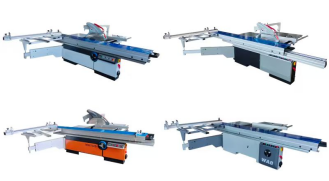
The precision sliding-table panel saw is a classic and widely used piece of woodworking cutting equipment; it utilizes a manually operated sliding table for feeding and supports both 90° straight cuts and 45° miter cuts.
Widely used in small to medium-sized furniture factories and custom cabinetry workshops for the production of diverse, small-batch items; capable of processing particleboard, MDF, plywood, melamine-faced panels, veneered panels, and solid wood boards.
Advantages: simple operation, high material compatibility, stable cutting performance, and competitive factory pricing;
disadvantages: relies on manual feeding, making it unsuitable for ultra-large-scale mass production.
2. Dust-free dual-blade panel saw (main and scoring saw)
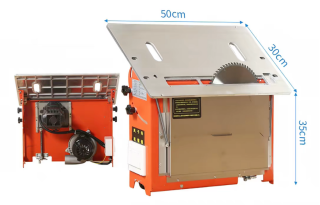
The dust-free scoring saw—a popular, upgraded model in recent years—features both a small scoring blade and a main saw blade. The scoring blade pre-cuts a groove into the surface layer of the panel, while the main blade performs the full-depth cut; this effectively prevents issues such as edge chipping, surface delamination, and burrs when working with melamine-faced or veneered boards.
The machine is equipped with a fully enclosed dust-extraction system that significantly reduces sawdust and airborne particles, meeting environmental standards. It is ideal for on-site renovation work, professional installation services, and small-scale workshops. The unit is compact, easy to transport, simple to set up, and highly reliable.
3. Fully automatic CNC panel saw
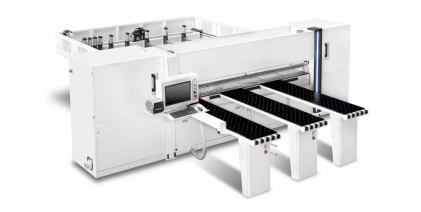
The CNC electronic panel saw is a fully automated, intelligent cutting system that supports automatic feeding, precise positioning, program importing, and batch processing. It can handle multiple panels in a single cycle with exceptional accuracy and consistent results across large-scale production runs.
Primarily designed for large-scale custom furniture factories and standardized mass-production lines, it significantly reduces labor requirements and boosts production efficiency. However, given the high capital investment and the need for operators to possess basic computer literacy, it is not recommended for use in small-scale, micro-workshops.
4. Vertical Panel Saw
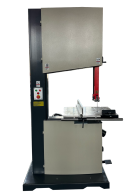
Vertical panel saws have a small footprint and are used for the vertical cutting of narrow boards and small auxiliary materials; they generally serve as supplementary cutting equipment rather than as the primary sizing equipment for a full-scale production line.